

September to December 2025 – Term 2
Schedule for Week 10- June, 2026
| Mon 15 | Tues 16 | Wed 17 | Thurs 18 | Fri 19 |
| Math Number names and numerals p.9-12, talk about it Act 1, Act 2 Hw: Act 3 | Math Sequence Numeral p13-15 Act 1, 2 | Maths Estimate a given qty p16-17 Point 1 Act 1 | Math Connection p.18 (exercise) | Math Quiz Chapter Review |
| Media & Info Literacy Use media and technology equipment with care | Social Studies Location of TT. p.7-8 | Grammar punctation mark: Question mark p14 POLLA | Science Metamorphosis, p.3-4 | Agri–Science |
| Grammar Use punctation mark: capital letter, full stop p.13-14-POLLA. Pg 21 CJE3 | Vocabulary/ Spelling – Rules Plural p.12-13 notes ex.1 (BG) | Creative Writing Write a plot structure: Title: Mr. Brown Goes to Town. | Oral Communication Activity: imagination, experience and listening skills to enjoy and connect to aural, aesthetic. Song materials | Creative Writing Intro to setting |
| Creative Writing & Penmanship Write a plot structure, p.29. | Creative Writing – Penmanship Write a plot structure p.35 | Vocabulary Spelling Rule, Syllables (part 2)- p.3-4 | Literary Appreciation Perspective: Three Little pigs | Vocabulary & Spelling. Rules, Syllables (part 3) p. 5 |
| Reading Read in isolation Seqrch for high frequency list 64 RR. list p.67 RR | Literary Appreciation see monday | Science Metamorphosis, p.1-2 | Grammar punctation mark: exclamation mark p.14 POLLA | VAPA 3 -dimensional objectives has shapes |
| Literary Appreciation Relate a story through another character’s perspective Pg 64 RR | Oral Communication Activity: imagination, experience and listening skills to enjoy and connect to aural, aesthetic. Song materials | Spanish The spanish names for the waters that surround TT (El Mar Caribe, El Golfo de Paria, El Océano Atántico, El Canal de Colón)) | VCCE: Discuss core ethical principles (integrity, respect, and responsibility) | PE Specific attire for PE classes |
Exercises:
Visual representation of this story. Read and have the students draw what they hear. Have a show and tell for the students.
That night, while they lay sleeping, came down on them terrible men, who lived with the bears in the mountains, like giants in shape. Each of them had six arms, and they fought with young firs and pines.
MEDIA & INFO lITERACY
- Objective:To explore the importance of media and information literacy, understand the impact of misinformation on perception and individual belief, and analyze the purpose of media messages.
- Duration: Approximately 60-90 minutes
- Materials Needed: A selection of news articles, social media posts, and advertisements (both real and fake), Access to the internet (for fact-checking), Printed worksheets for group work, Whiteboard and markers, Sticky notes, Chart paper
- 1. Introduction (10-15 minutes)
- Begin with a brief discussion about what media literacy is and why it’s important. Ask students what types of media they engage with daily (e.g., social media, news, television).
- Discuss misinformation and its potential effects on people’s beliefs and perceptions. Ask questions such as: – How can a false piece of information change someone’s opinion? – Why is it important to verify information before believing or sharing it?
- 2. Group Work: Sorting Media Messages (20-25 minutes)
- – Divide students into small groups and provide each group with a mix of media messages (fictional news articles, clickbait headlines, legitimate news sources, and advertisements).
- – Give each group a worksheet with the following tasks:
- 1. **Identify** whether each message is likely true or false based on its content.
- 2. **Analyze** the purpose of the media message (e.g., to inform, persuade, entertain, sell).
- 3. **Discuss** how they can tell if a piece of information is trustworthy or not (look for sources, author credibility, etc.).
#### 3. **Fact-Checking Challenge (15-20 minutes)**
– After sorting the messages, have groups pick three media messages they found questionable.
– Instruct them to use online fact-checking resources (like Snopes, FactCheck.org) to investigate the veracity of these messages.
– Each group will report back on their findings, explaining what they discovered and how they came to that conclusion.
#### 4. **Class Discussion (15-20 minutes)**
– Gather the class together and ask each group to share one message they analyzed, their findings, and what led them to their conclusion.
– Lead a discussion on:
– How misinformation can spread and its potential consequences in real life.
– The role of critical thinking in analyzing media messages.
– Ways to improve media literacy in themselves and their peers.
#### 5. **Reflection and Wrap-Up (10 minutes)**
– Ask students to take a sticky note and write down one key takeaway from the activity about media literacy or misinformation.
– Collect the sticky notes and create a “Media Literacy Wall” in the classroom as a reminder of what they learned.
### Optional Extension:
– For homework, students can watch a news segment or read an article and write a short reflection on its purpose, potential biases, and how they would verify its accuracy.
Creative writing activity
Activity of Creative Writing: Draw up a character profile of a person and then create a list of interview questions for a character they are developing. They can then write the responses in the character’s voice. Questions could include their background, dreams, fears, and favorite memories.
Poem Project
Study Skills: List of words to read and place in alphabetical order: special, whistling, precious, fallen, louder, sweetest, delicious, heavier, hungrily
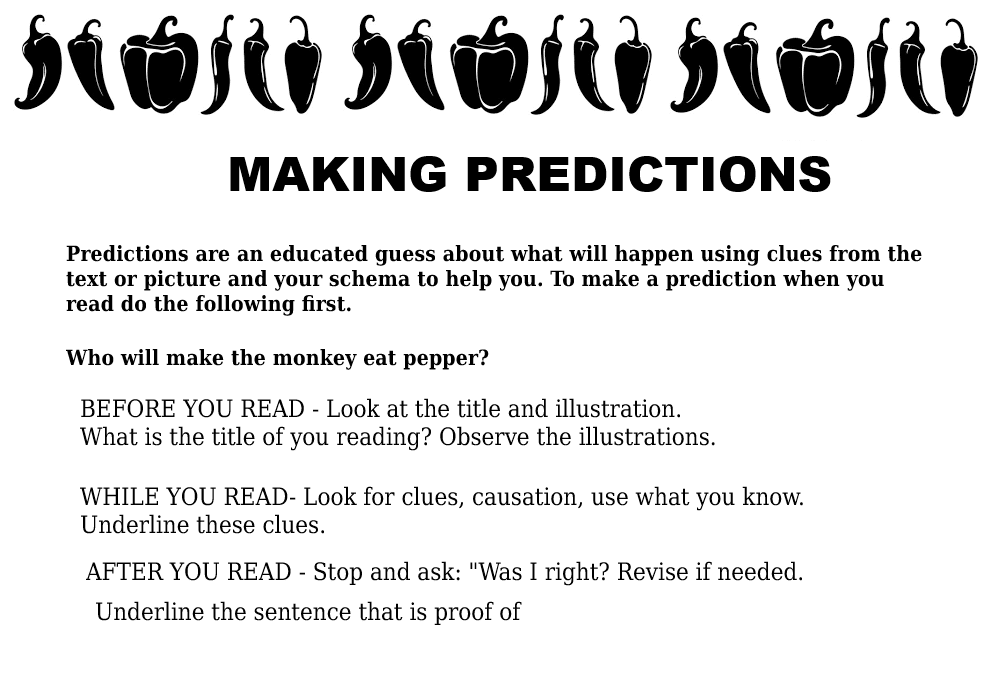
Making predictions:
General Science Group exercise:
Science HomeWork: Poster Guidelines
Create a poster that represents a specific terrestrial or aquatic habitat, including its characteristics and inhabitants. eg. a pond, river, savannah, tree top,, etc
- Explain that each student will create a poster representing their assigned habitat. Posters should include:
- Title of the habitat
- Drawings or pictures of representative organisms
- Key characteristics
- Interesting facts
Journal writing
- Wednesday: Journal writing: discuss how pre-writing helps organize thoughts and improves writing quality.
- Friday: Use graphic organizer to practice brainstorming. Topic: Yesterday, my uncle and I rode our bicycle to the park.